


To borrow from The Usual Suspects: the greatest trick the AI overlords ever pulled was convincing the world that AI replacing human labor and creativity was inevitable.
As it happens, it seems that this trick was not nearly as successful as that which Verbal Kint (by way of Baudelaire) ascribes to the devil. As we get deeper into the AI "revolution," it seems the numbers who have truly bought in on AI are rapidly dwindling. Increasingly the remaining true believers can be reduced to a shrinking but increasingly messianic cluster. Let's start, appropriately, at the top of the pyramid and work our way down the layers of the cult.
- The current and would-be .1% who dream of a future without messy humans, the coming storm to be ridden out in their sprawling bunker-compounds in Hawaii/New Zealand/Argentina/Mars.
- Politicians who are depending on the financial backing of the above in the short run and a utility closet in the bunkers in the long term.
- CEO/CIO/CFO/COOs who have gone "all in" on investing in AI and can't afford to pull out now or their stocks will tank and they will be out on the streets.
- The upper managers at the above companies whose promotions and chances of having jobs when the collapse comes are 100% tied to telling the CEO/CIO/CFO/COOs that the future of the economy is 100% AI.
- Companies selling shovels and picks to the above, including chip manufacturers, data center builders, and component manufacturers.
- Founders of startups whose entire business model is predicated on churning out AI-driven (and -generated) software tools to fill needs that no one realized were in fact "needs" until these new businesses started irrationally attracting billions of dollars in venture capital.
- Investors in the above who are now so long on an irrational market in unprofitable companies that, like Wile E. Coyote, they cannot for a second look down for fear they will see the lie they have been telling themselves.

Wile E. Coyote is the perfect mascot for the AI "economy": "Surely the laws of physics no longer apply now that AI has come to town," investors tell each other, all the while muttering compulsively "don't look down, don't look down...".
Sadly, the next layer down in the pyramid (#8 for those keeping count) has no such need for caution because they truly believe the .1% can fly and they will follow them anywhere. These are the cultists who want the folks at the top of the pyramid to succeed so they can prove all the naysayers wrong and tweet about it (X about it?), or so they can be transmuted into the cloud, or so they can get a job as a butler at the tech lords' compound, etc.
Finally, coming in at #9, we have a small but growing cluster of the most vulnerable true believers whose stories will almost inevitably end badly—often tragically. Here I am thinking of the growing ranks of the desperately lonely and broken who have found in their LLM a romantic partner, or a therapist, or a cheerleader in their lonely quest to discover the Theory of Everything, or an enabler encouraging their plans to commit terrible harm to themselves or to others. These stories are piling up like cordwood, increasingly leading to lawsuits against the AI companies which the AI lords shrug off like gnats. After all, when you have committed your company to unfathomable debt and to justifying incalculable harm, a few billion as lip service to society's quaint morality is a small price to pay.
That is pretty much it for the ranks of the true believers. Sure, there are many who are genuinely fascinated by the technology itself and who find in a very limited and focused version of AI a useful tool in support of their work or business. As I have made clear, I am part of this vast majority of LLM users—excited by possibilities which have nothing to do with the snake oil the silicon valley corporations are selling us. AI does not need to be what those who have captured the technology tell us it must. By disseminating a vague and protean definition of AI, Silicon Valley has made it harder for society to talk back to their narrative of inevitability. But the young people who have been using AI longer than most of us are increasingly running out of patience.
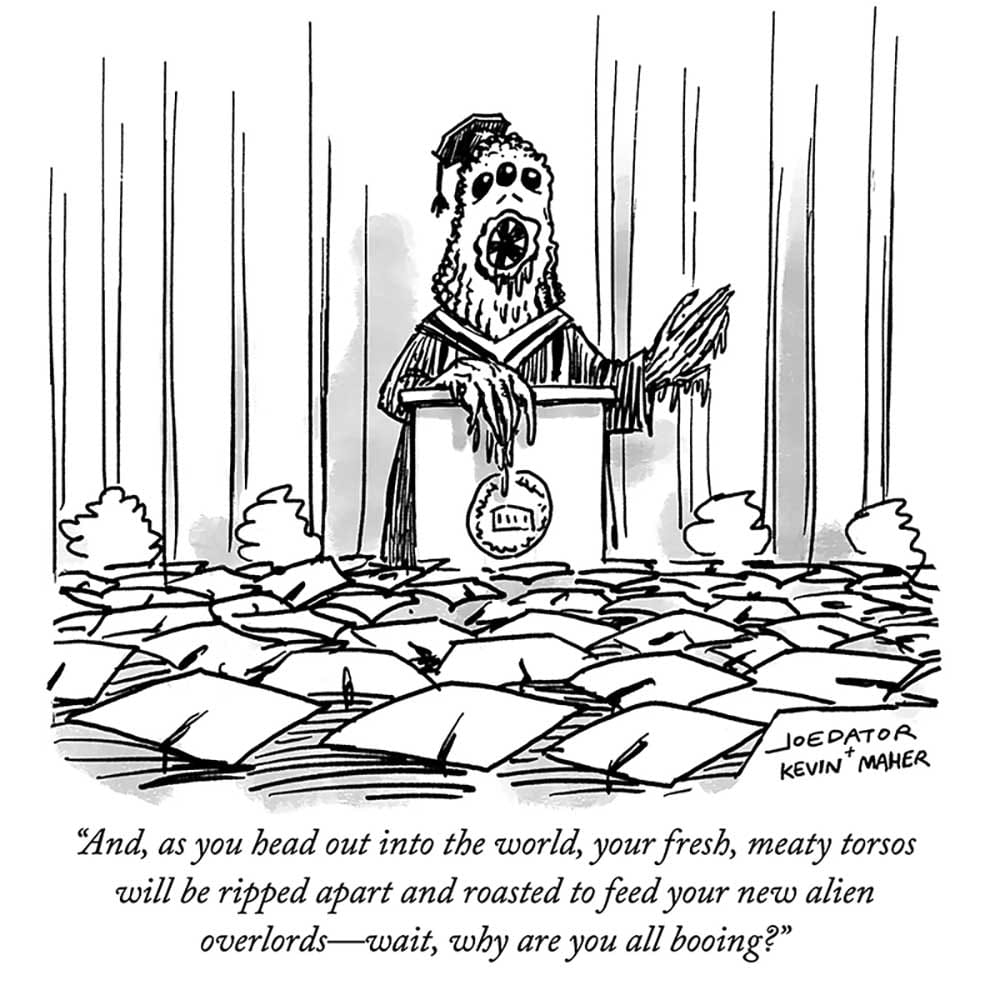
No group is moving faster into the negative camp—ranging from skeptical to outright hostile—than college-age students. We saw this on spectacular display during the last round of spring graduation ceremonies, but it had been building during the preceding year. Those jeering included some who feared the impact of AI on the climate, some who feared that AI was laying waste to the career path for which they had just spent years training, and some because they saw the ways in which AI devalued their education, the biggest investment of their lives. But many, and likely most, were booing for the same reason young people have booed old people since time immemorial: because the old people were telling them they had no choice, no agency, and could only hope to adapt ... or die.
By the time many Stanford graduates walked out on Google-boss Sundar Pichai in June of this year, Pichai was aware of the blowback—and the critique of Google's involvement with US military and Israel, which motivated the walkouts. The graduation rage against AI glazing had been a story for several weeks, and he wisely avoided talking much about AI in his remarks despite being in the inner circle of the upper echelon of the .1% Mountainhead Club.
It was the earliest ceremonies in May that were especially breathtaking because it is quite clear that the students themselves did not originally come primed to protest and their reaction was wholly spontaneous—and utterly disabling for the speakers. Former Google CEO Eric Schmidt encountered boos, beginning with his reference to Time naming "Architects of AI"—specifically Sam Altman, Dario Amodei, Demis Hassabis, and Jensen Huang—as "person of the year" His larger point was one many of those booing would have likely found sympathetic. As he pointed out, he had finished graduate school in 1982, the same year the personal computer had been named "Machine of the Year." His generation had failed to steward responsible use of the computer and the internet, he argued, calling on the students to do better with AI.
But his would-be point did not matter. The students were first enraged by the very thought that the AI tech lords were person of the year, which they found galling for all the reasons we have discussed. But their anger was also directed at Schmidt himself.
"To speak of the future as though it has already been decided is to surrender the one thing that actually matters. You are surrendering your agency," Schmidt exhorted the graduates. "The future does not simply arrive. ... And the people building it will be you and people like you." To his consternation, the boos continued. Schmidt was certain that the students were missing his argument, but they weren't missing a thing.
Schmidt has been one of AI's most vocal evangelists, including co-authoring two books with (of all people) Henry Kissinger, The Age of AI: And Our Human Future (2021) and Genesis: Artificial Intelligence, Hope, and the Human Spirit (2024). In a 2025 TED talk he insisted that AI was under-hyped and has called on the U.S. to go all in on data centers in what he insists is an AI arms race with China to control the AI-driven future. Despite his exhortation to the graduates to claim their own agency, everything Schmidt has said in relation to AI—from his militant resistance to regulation to his insistence that we must create countless gigawatts of new power to drive data center growth—has told the opposite message.
Other speakers receiving resounding negative reactions at their graduation addresses include people not in any way directly connected to AI but who fall into the second tier of believers described above. This includes Big Machine Records founder Scott Borchetta, who told students that "AI is rewriting production as we sit here.” When this was greeted with some boos, Borchetta took it strangely personally—as the All-In zealots tend to do—and tersely scolded the students: “Deal with it!”
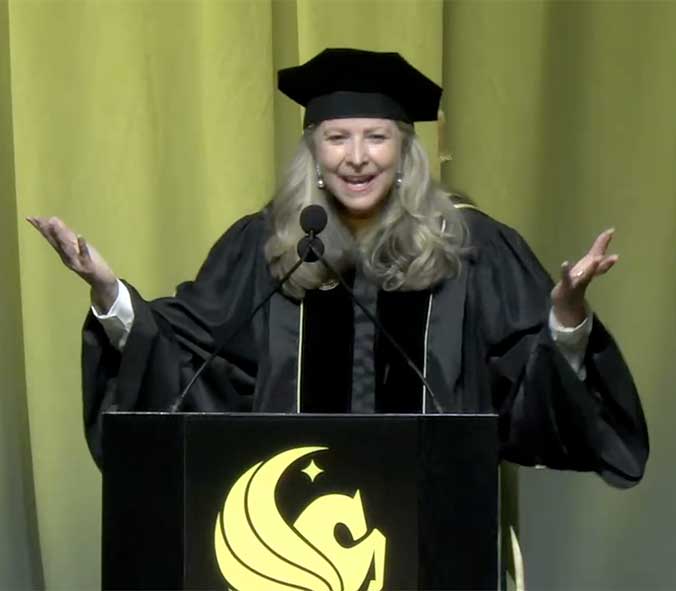
Perhaps most widely publicized was the speech of Gloria Caulfield, a real estate executive, who was caught utterly unprepared for the response to her remarks at a ceremony at the University of Central Florida. “The rise of artificial intelligence is the next industrial revolution,” she said, addressing students from Arts & Sciences and Communications—many with new degrees in disciplines under imminent threat from AI fabulists. When the crowd booed, she was genuinely confused.
“What happened?” Caulfield stammered, looking over her shoulder, as if perhaps the crowd were reacting to something unsavory that had taken place behind her. Seeing nothing, she braved onwards.
“OK, I struck a chord! May I finish? Only a few years ago, A.I. was not a factor in our lives.” The crowd erupted in cheers.
“And now, A.I. capabilities are in the palm of our hands.” The chorus of jeers returned.
The disconnect between the "All-In on AI" crew and the rest of the country might have first become truly visible during this past graduation season, but it has widened considerably since then. I asked university leaders if they are prepared to navigate this rising tension between their own AI initiatives of 2024 and the rising chorus of refusal we have seen over the summer at town halls protesting new data centers or with the dismantling of Flock cameras across the country. As always, the answer is something along the lines of suggesting that it is up to each department to "figure it out," which is of course putting it all on the traumatized frontline workers in this crisis—something like asking ER nurses in April 2020 to solve COVID while intubating patients.
One of the biggest mistakes commentators make is assuming that, because many students do use AI to complete coursework, they are true believers themselves. This is an utter misreading of the situation, and I have been struggling to come up with analogies to explain it in terms both the doomers and the boomers would understand.

When I talk to my students about AI—and these are students from a broad range of majors—they universally express sadness or anger (often both). Many, but far from all, acknowledge using it in their coursework in ways that leave them feeling ethically compromised. I ask, of course, why they continue to use it if they know doing so will leave them unhappy for taking a shortcut on their education. The answers are not surprising.
Some talk about time-management issues, personal crises, and other aspects of being nineteen that I remember all too well. As someone with undiagnosed ADD when I was in school, I am not sure how I would have resisted the temptation of LLMs had they been available to me. And, as I confess to my students, had I failed to resist, as seems almost inevitable, I would not be their professor today.
Here AI is akin to an addictive drug left out on the counter with an "EAT ME" sign. The addict does not want it and truly believes they can resist the habit, but then life or best-laid-plans unravel and there it is, all wrapped up in a bow and free for the taking, promising a quick reset. Yes, students use AI, but they do not like it and they so very much wish they could stop.
More common among the engineers and business students is a profound sense that everyone else is doing it, to the extent that not doing so will put them at a disadvantage—especially in classes with curves. When I ask how many students openly brag about using it, they admit the numbers are low, but they assume—not irrationally—that these are the loudmouths telling the truth the others have enough shame not to share.
Here the best comparison is to the battle royale in which, as in Hunger Games, they find they have been pitted against each other in a fight to the death, forced to use all available weapons to make up for the disadvantage they are certain the game has dealt them. Few relish the weapons or the inherent violence of the game, but they have been acculturated increasingly to visions of a bleak future in which they must fight for diminishing opportunities using the very weapons that are diminishing those opportunities at an accelerating pace.
And then, most heartbreaking of all, and newest to the university classroom, are those students who have been using LLMs since middleschool and have until now never been called out on it, never been told that doing so might well constitute academic misconduct. And now, of course, they not only have no writing skills of their own, but they have surrendered multiple opportunities to learn about their own thinking through the process of learning how to communicate their ideas in language. Their confidence has crumbled at the outset of their college careers, and they don't know how to begin to recover what they have lost as the stressors of university come down on them. They have surrendered before they even began, even as they hear AI doomers blame them for everything wrong with their generation.
All of these students use AI. None of them are happy about it. I know that students exist who relish using AI in ways that clearly constitute academic misconduct. But I have yet to meet one among the many students I teach. Not one could be accurately placed in any of the various ranks of true believers detailed above. None would shed a tear were AI to magically cease to be available tomorrow—so long as it was not available to anyone.
I sit on the faculty advisory committee for our university's AI Fluency Initiative. This year I will also be working at the department level on these issues. I believe that talking about AI—its potential but also its real and present dangers—is something we should be doing across campus and at all public institutions at this moment. For me, being "all in" on AI means being relentlessly focused on it, the way we would address any crisis threatening the well-being of our students, the environment, the economy, and the future of humanity.
What makes this global crisis different is not its inevitability or the possibilities that it will—if we only give a few more billions to the AI Overlords—achieve AGI and solve all the problems to which it is contributing. It won't. No, what makes this different is that, unlike COVID in 2020, this is a crisis that is wholly the result of bad actors who have seized for their own profit and grandiose Lex Luthor fantasies a technology that has real potential to improve health care, scientific discovery, accessibility, wildlife conservation, and communication across linguistic and cultural divides among many other real world benefits we are already seeing.
While there are those who insist that the coronavirus of 2020 was released from a research lab, AI is a technology that was developed in university research labs only to be stolen by private industry, locked behind a moat of absurd data and processing "requirements" that made the technology inaccessible to the public sector that had developed it. Going all in on AI must be first and foremost about refusing the demands of the billionaire class who have claimed this technology as their own. It must be a unified commitment on the part of the vast majority not counted among the true believers detailed at the start of this post to reclaiming AI as a collective property that belongs to the public and which must be used (and regulated) in the public interest.
This is why AI literacy is so vital at this moment in our history—not so we can train our students to "adapt" to the demands of an industry working to make them obsolete, but so we can educate our students and ourselves on how best to demystify AI, to bring it down to size, so that we might reclaim it for research and the good of humanity and the planet.
When we accomplish this, students will no longer use AI in ways that ultimately hurt themselves to the benefit of AI Inc.—at least no more than they did a decade ago through more traditional modes of academic misconduct. Only when they understand how AI works and what it actually is will they fully understand why offloading their humanity to AI is precisely what the people they are booing most want from them. Only then can we all be prepared to start planning how we can claim agency over what AI becomes after this bubble bursts and the Silicon Valley moguls are reduced to cautionary tales in the dust-heap of history.
Now that is a version of an AI future towards which all of us would be prepared to go all-in. That we find no such initiative at any university in the country is something we need to tackle in this coming academic year before we lose a generation of students to the scholasticide the current federal government and their silicon valley sponsors have set in motion.
Subscribe (always free)
Subscribe (free!) to receive the latest updates




Member discussion