


On Monday three weeks ago, I woke to a summons to attend an emergency meeting. Such a message never portends good news. As it happened, I had a medical appointment so I had to wait for the update, which a senate colleague texted a short time later: "At 10am today, the university will announce that the president is resigning. He had an inappropriate relationship with a woman seeking state funds and offered to resign, and the board accepted."
At the time, my first thought was not of the details of the scandal or the betrayal of trust, although those would make claims on my attention in the days to come. Instead I found myself having flashbacks to all the leadership transitions I had been through in my time at the university. The next president or interim president, I realized, would be my twelfth.
This one felt especially hard, and not due to the loss of Ted Carter himself. Despite spending more time with him than with any of his predecessors, in some ways I had less of a sense of him as a person than I did of some previous presidents I had never even met. He was not, to put it mildly, an outgoing leader, and he had been president through a particularly tumultuous period in higher education that compounded a natural tendency among central administrators to retreat to the confines of the command room.
Making matters more challenging, Carter had started his presidency at a disadvantage with many faculty and students. He arrived without a terminal degree, the first time that had been the case at OSU since the 19th century. As a retired vice admiral and former president of the Naval Academy, he certainly had leadership experience. But aside from three years at University of Nebraska as a COVID-era president, Carter had little experience with traditional institutions of higher education.
His opening months got off to a rough start. He started in January 2024, and by May he had two more strikes against him. First, in April, he managed the student protests against the war in Gaza with an exceptionally heavy hand, resulting in the most arrests at an OSU campus protests since the end of the 60s. While his decisions had some supporters on campus, for those already inclined to approach his appointment with deep suspicion it was confirmation of their worst fears.
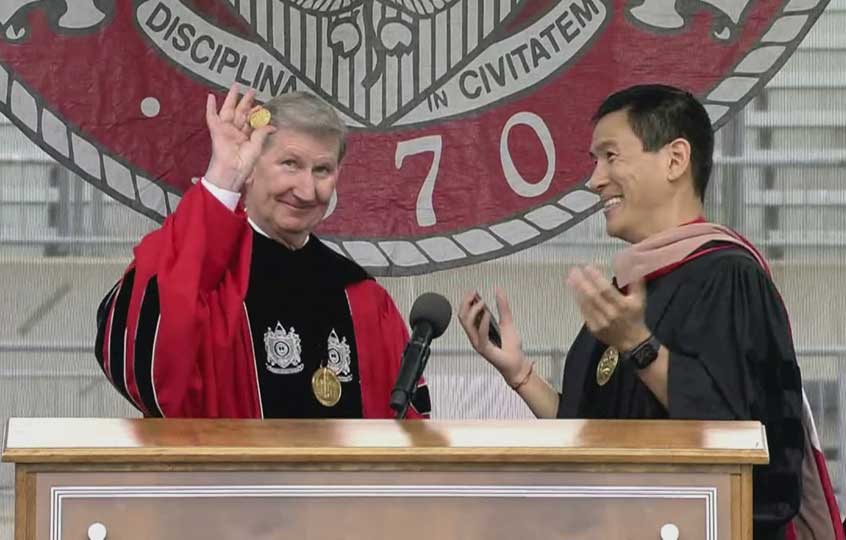
And then there was the graduation speaker at the May graduation. Spring graduation at Ohio State is a massive event, and the speaker selected for 2024 was a surprise to everyone. Few had heard of Chris Pan, and he was not among the names recommended to the president by an advisory committee. It was Carter's choice to invite Pan (although he certainly danced around that in his conversations with senate leaders following the debacle). What I did not know, as he handed the microphone to someone who proceeded to pitch Bitcoin to 70,000 people, was that Carter had a substantial financial stake in the Bitcoin industry.[1]
And yet, even with all of this in the debit column, I understood why the Board had sought him out. This was spring of 2024, six months before the election that would turn higher education and the world inside out, and yet already the winds were blowing a storm our way.
As is the case at many state institutions, our trustees are appointed by the governor. While most come from the world of business and philanthropy, they are all sufficiently plugged into the world of politics as to be on the governor's radar. They certainly knew what was coming, because they were hearing it from downtown, with growing frequency and intensity. In fact, it was this knowledge that almost certainly contributed the final straw to the decision to ask for the resignation of Carter's predecessor, Kristina Johnson just a couple of years earlier.
Kristina Johnson joined the university in fall 2020. By November 2022 she had announced her intention to "resign," effective at the end of the academic year. Shortly after Johnson's departure, Melissa Gilliam, who had started as provost in 2021, was looking for a new home—one she found as the next president of Boston University, starting in October 2023.
What followed was an extended period of institutional limbo, much of it without even an interim president, as the Board served in an executive function for the university while conducting the search for a new chair. Only after Carter had been identified as the university's next president was an interim president named to hold the fort until his term began. It would not be until January 2025, a full year after Carter's start date, that a new provost would replace Gilliam.
While the official story was that Johnson had resigned, the official-unofficial story was that Johnson had been forced out due to conflicts with members of the board, including Les Wexner in his role as chair of the board of the university's medical center that bears his name. This was all certainly true, and there were rumors that much of the animus between Johnson and Wexner involved the replacement of the medical center's CEO. Nonetheless, there were signs that Johnson had been attracting the wrong kind of attention from powerful legislators downtown.
The very qualities that made Johnson popular with many students and faculty—her outspokenness on political and social justice issues—quickly became a liability. Just a short time into her presidency, Johnson released a video condemning the decision of a Kentucky grand jury to bring no charges against the Louisville police for the killing of Breonna Taylor: "Breonna Taylor deserves justice and this does not feel like justice," she said. "We cannot accept what has happened in Louisville." The breakdown in the justice system and the killings of unarmed Black and Brown people in our country has become all too familiar," she continued. "This isn't going to stop until we create an anti-racist world."
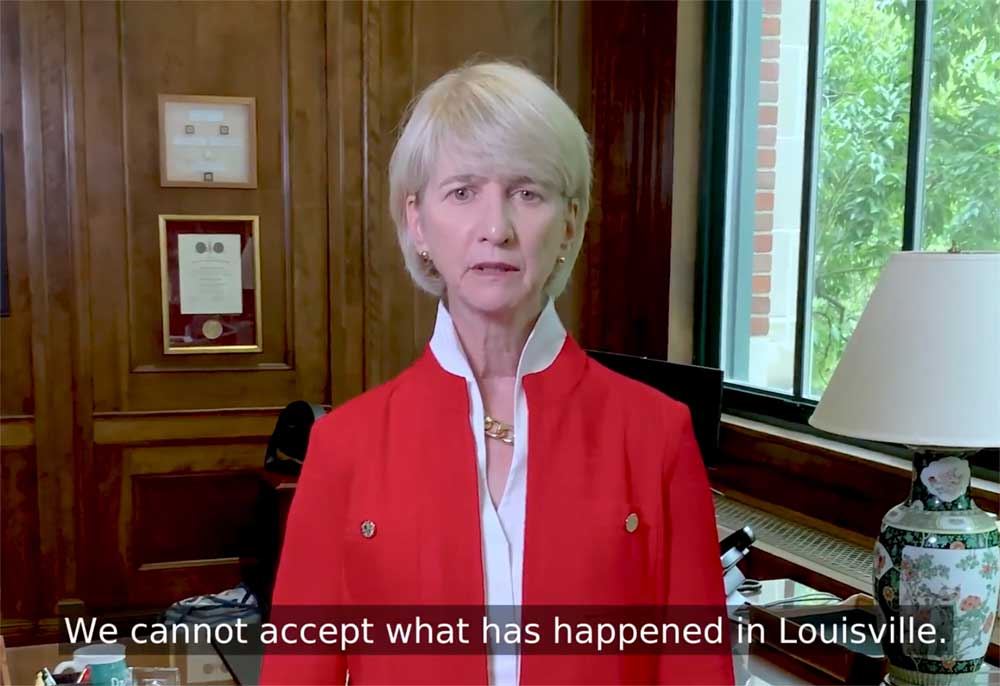
At this time, I was actively involved with the BLM protests in Columbus. As an individual citizen, Johnson's words aligned with my own beliefs regarding the grand jury decision and the larger crisis of institutional racism which the murders of Breonna Taylor, George Floyd, and so many others made plain. But I did not need, or want, her to speak these words on the university's behalf.
I want to spend some time with the reasons why I believed then and still believe today that Johnson's presidency was every bit as bad for the university as was Carter's. I won't call them "failed presidencies" because, as I will argue in the next installment, such a characterization is redundant in the 2020s. Instead, I would define both presidencies as damaging. They both left the university worse than they found it. In Carter's case, this is perhaps obvious in the disastrous choices he made personally and ethically in the position—especially given the role as "embodiment of integrity" he was hired to perform. Add to this his draconian approach to campus protest and the blanket bans on chalking, dorm decorations, and land acknowledgements in syllabi and we have a presidency that contributed to the deepening of a chill on speech in excess of what even this dark moment required.
Given all that, one might imagine I would join so many of my colleagues in being nostalgic for Kristina Johnson's presidency. I do not. If Carter made us a poster child for the silencing of free expression through policies and interpretations of the law under his leadership, Johnson made us the poster child for a very different kind of chill, one whose consequences are all too visible in 2026.
Let me state the obvious. I am a passionate believer in institutional neutrality, oxymoronic as that might sound. Like the AAUP, I do not believe that "institutional neutrality in all of its varied meanings" is "necessary or sufficient for academic freedom to flourish." I do, however, believe that it is necessary for the free expression of the 100,000 faculty, staff, and students who make up my university community. A university president taking a position on behalf of the institution—saying what "we" feel or "cannot accept"—necessarily places limits around the expression of the rest of the community, even those who agree completely.
As I have discussed elsewhere, as a state employee I have first amendment rights protecting my individual speech, rights to which I would not have legal access if I worked at a private institution that sought to punish me for my speech outside of my role as a professor. I cherish those protections, and all the more so given how much they have been severely threatened in the past year in ways I could not have imagined in 2020. I believe that every member of the community—student or employee—should be free to speak their opinions as individuals without having to worry what the university's president has determined "we" think about a position.
We complain, and rightly, about the chill on speech imposed by state laws like SB1 and endless federal inquiries and investigations. And yet there was insufficient care as to the ways in which Johnson's speech as university president itself produced a chill. This is certainly the case for those who disagreed with her on these issues. But it was also the case, whether they knew it or not, for those who wholeheartedly agreed with her—because once you know the institution has a position one cannot help but consider how your own positions on a broad range of issues align with those of the institution. And when the university does not take a position on an issue about which you feel passionately, it becomes impossible not to see in the silence a statement that this particular issue is not worthy of consideration.
For those who found Johnson's speech brave or inspiring, it is always worth pausing to consider how they would have felt had the university president spoken out at that moment in support of the decision of the grand jury and in vehement defense of the officers involved. We like institutional speech when we see our opinions reflected in its words. But in a parallel universe where she had articulated the opposite viewpoints, it is hard not to imagine that the demands for the president to not speak for all staff and students would have been swift and resounding.
Of course, Johnson's decisions here to speak out in her role as president did damage whose full impact would not be felt immediately. Rightwing internet media commentators like the Gateway Pundit seized on Johnson's statement, amplified it, and added it to the arsenal being stockpiled for a future in which a concerted effort could be made to dismantle all diversity initiatives and programs dedicated to addressing institutional racism.
While we did not know it at the time, the writing was on the wall following her state of the university speech in 2021, in which she launched the RAISE initiative—Race, Inclusion and Social Equity—with the goal of hiring 50 faculty members "who are scientists, artists and scholars who are addressing social equity and racial disparities" as well as "100 RAISE faculty hires who are from underrepresented communities." As Johnson said: “I want every single Ohio State student to be able to look across the lecture hall or seminar table and understand immediately that their dreams are valid and achievable.”
Sitting in the audience at that event, I was of course thrilled to hear we would finally be hiring 350 faculty members. Hiring had been stalled since well before the pandemic, especially in Arts & Sciences, and overall numbers of tenure line faculty were down. I confess to being sufficiently distracted by that number that I did not register the part that the board—and many people downtown—heard loud and clear. Johnson was saying explicitly that we were going to hire faculty "from underrepresented communities."
In a recent a recent article, The Chronicle's Emma Pettit tells the story of the rise and fall of higher education's diversity hiring initiatives, focusing on Ohio State's blurring of the crucial distinction between creating the conditions for a diverse pool on one hand, and the privileging of race or ethnicity in the selection of the successful candidate. For my first 25 years in the profession, this distinction was rigorously policed. Search committees were always encouraged to publicize a job opening so as to make available to as broad and diverse applicant pool as possible. But hiring training also emphasized that once the applicants' materials arrived, the committee was to be solely focused on finding the most qualified candidate, regardless of any other factors or institutional goals.
In announcing that the university was going to hire 100 faculty from an "underrepresented community," Johnson was flouting labor law and unraveling years of HR training. She was also undermining the many remarkable faculty of color we had hired over the previous years by given cover to the false narrative from outside the academy that race and not the quality of their work was the reason they were at the university.
Pettit and I touched base while she was working on the story. I was surprised when she read out to me the quote from Johnson's 2021 state of the university. "That cannot be right," I said. "I was there." I remembered Johnson calling for the hiring of faculty to work in areas of research that address underrepresented communities—but surely not hiring faculty of color explicitly.
What I was remembering, Pettit suggested, was the result of a rapid scrubbing of the official channels as to the details of what had been said. I was remembering the message sanitized to make the plan legal. I had to dig into the Internet archives to find evidence that what Pettit said was true. Not that I didn't believe her: I know her to be a careful historian and chronicler of higher education. But still I was stunned that I had sat there and heard Johnson say the words, and yet did not hear them.
We did not know at the time that Johnson had not alerted the trustees to her RAISE initiative before making it public. The members of the board in attendance must have been shocked by what they were hearing, but also terrified as to what was surely coming next. John Sailer of the Manhattan Institute certainly heard, and he would file public records requests for information from Arts & Sciences searches for 2021-22 and 2022-23 that would provide enough fodder—some of it cherry-picked, some of it speaking all too clearly in its own words—to power the state legislature's crusade against 'DEI' at the university over the finish line in early 2025.
So I greeted Ted Carter in the spirit which I am certain the trustees intended: as an antithesis to Johnson. I don't mean politically. I have in truth no idea what Carter's politics are, and to my eyes that was a feature not a bug. Carter's job was to help buffer the attacks coming out of the statehouse, and to galvanize confidence among those who had begun to distrust the university and higher education as a whole. His job was to perform stolid integrity on the institution's behalf in what was even before the 2024 election a worsening political climate for higher education.
Carter hadn't been hired to be popular with faculty and students, which is good because it was never going to happen—especially after the protests of April 2024. But he was hired to appear unimpeachably respectable before business leaders, legislators, donors, and alumni. There was every reason to believe he could perform that respectability for several years, potentially even retiring as a sitting president. But his public betrayal of his wife and his responsibilities as a public employee quickly ended that narrative. Different recipe, same failed result.
So it was I found myself that Monday, despondent over the prospect of another year or more in institutional purgatory, another $500,000 spent on a national search, another "new beginning" with new initiatives we all had to pretend to believe in, as if somehow it would come out different this time around.
Worst of all, as far as I was concerned, we were surely going to lose our Provost, just as we had lost Melissa Gilliam when Kristina Johnson was pushed out. Ravi Bellamkonda had made no secret of his goal to one day be a university president, and it was hard not to believe he was not already on the phone to the head hunters who circle like vultures around individuals in top academic leadership.
And then, around 30 hours later, the senate faculty leaders were informed that Bellamkonda would be our next university president. By Thursday morning it was official.
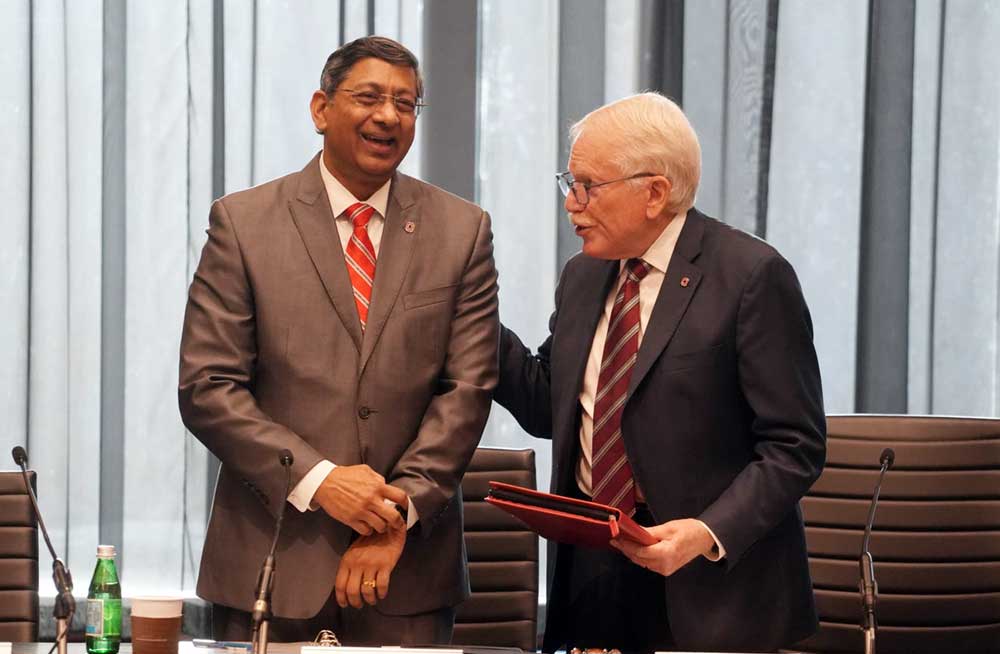
I was teaching when the new president was formally welcomed to his new role, but shortly after my class I agreed to talk with Emma Wozniak from the Columbus Dispatch. I'm pretty sure she made me sound more coherent than I was that day:
"I can say without any hesitation that my biggest fear when the news broke about Ted Carter was that we would go through a period of limbo and drift as we did after Kristina Johnson's departure," Gardner said, referring to Carter's predecessor. "It took us several years to have stable leadership, and we had stable leadership in the president and provost for a little over a year. I think to go back there would have set the university back tremendously."
...
“Every other issue we have, I will push for and argue for a shared governance involvement, and in different conditions, in different times, I would have argued for a more inclusive process here," Gardner said. "But this was unusual times, and a time-sensitive moment in our history as a university, and as a country. I would say that it was a courageous decision."
Needless to say, my sentiments were not universally shared. As the article points out: "Hundreds of faculty, staff, students and alumni beg to differ," having signed a petition demanding "a transparent, inclusive, open search for the next president—one that involves meaningful participation from faculty, staff, and students ... instead of another secretive process controlled by unaccountable trustees."
I will see their differ and raise them a couple of differs of my own. My goal in what follows is not to say that there is anything wrong with wishing for "a transparent, inclusive, open search for the next president." But in addition to the very good reasons we did not want a protracted search at this moment in the university's history, there are good reasons why faculty should not want to be making claims on the choice of president for a university—a decision which by our own rules belongs exclusively to the board.
I will think aloud through all of that in the next installment, along with a meditation on the bizarre job of being a university president in the 2020s.
- Carter had joined Bitcoin miner TeraWulf's board of directors in 2021, earning annual cash retainers of $60,000 as a board member and $25,000 as audit chair, plus stock awards of over $90,000 in fiscal year 2023. ↩︎
Subscribe (always free)
Subscribe (free!) to receive the latest updates



Member discussion